Using a podcast for enterprise sales enablement means producing episodes your sellers can deploy inside live deals: conversations that answer a specific stakeholder’s objection, feature a peer from a comparable organisation, or give a champion something credible to forward internally. The audience that matters is the buying committee on your named accounts, not the download chart.
That distinction decides whether the show earns budget. A podcast measured on downloads is a publishing exercise. A podcast measured on which accounts in open pipeline consumed which episode, and what happened to those deals afterwards, is a sales asset that happens to publish publicly.
What does enterprise sales enablement actually need from content?
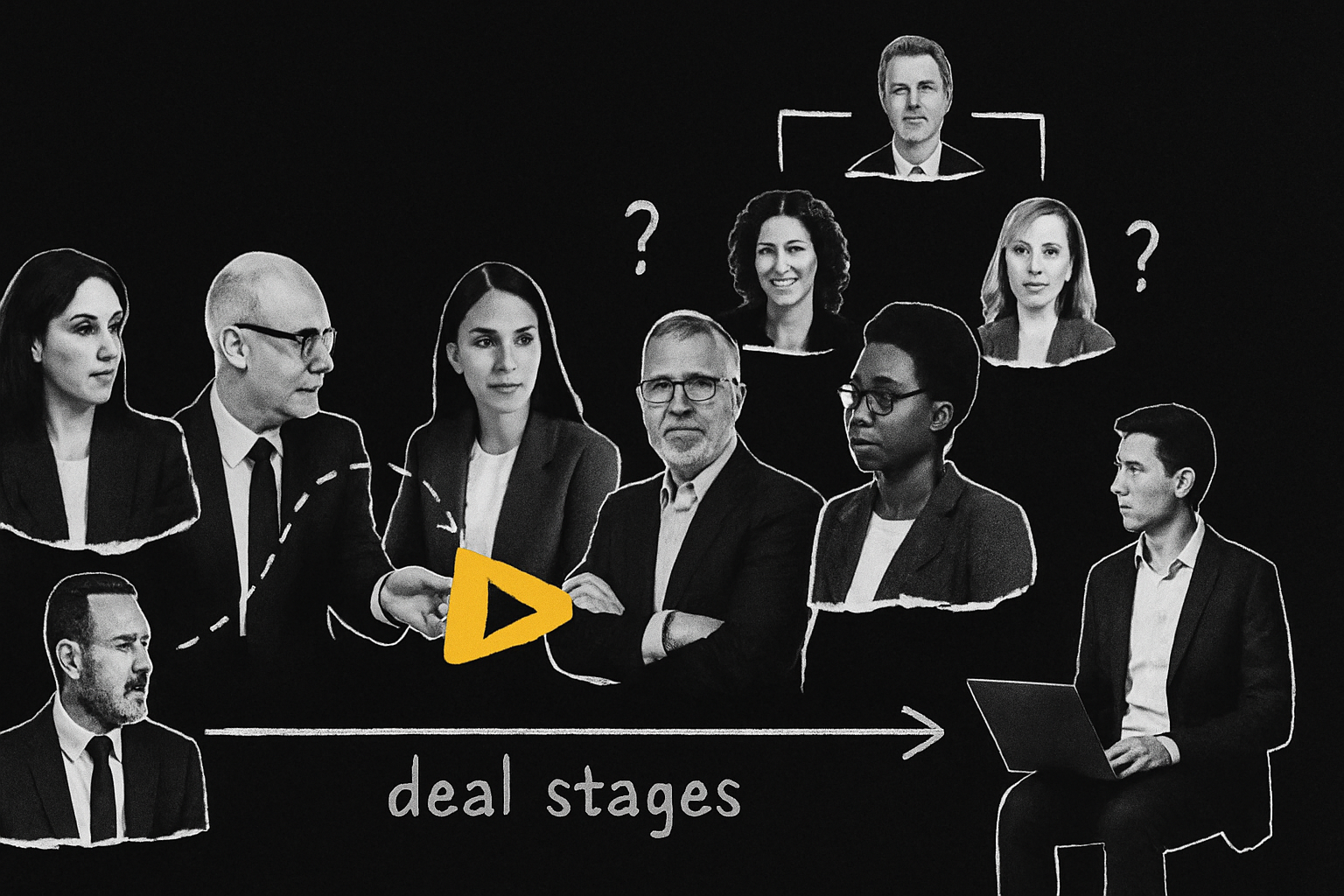
Enterprise deals are decided by people your rep never meets. The average enterprise deal now involves 10 or more stakeholders. Your champion sits through the demo, reads the deck, gets genuinely excited. Then the CFO is looped in at week nine, has never heard of you, and asks a question nobody prepared for. The security lead gets forwarded a link on a Friday. A board member wants assurance from someone who is not on your payroll.
Sellers are structurally unable to solve this. One rep cannot be in eleven conversations, and the conversations that kill deals happen in rooms they are not invited to. What travels into those rooms is content: a link a champion pastes into Slack, an episode a technical evaluator listens to on the drive home, a clip an exec watches because a peer they respect is in it.
Sales enablement inside most companies is organised around internal readiness. Onboarding, product training, competitive battlecards, sales kickoffs, certification. That work matters, and it is what most enablement conversations cover. It is also entirely inward-facing. It makes your reps sharper in the meetings they get. It does nothing for the eight stakeholders who form a view of you without ever speaking to a human at your company.
A podcast built for enterprise sales enablement works on that second problem. It puts a credible, human, unpolished version of your company’s thinking in front of people who would decline a discovery call and delete a nurture email.
How do sales teams actually use podcast episodes?
Concretely, in four places in the cycle, and the value is different in each.
Before the first call, an episode is a reason to reach out that is not a pitch. A rep who can say “we had your former colleague from a similar organisation on the show talking about the exact migration you are about to run” has an opening that a sequence cannot manufacture. The episode is the pretext and the credibility at the same time.
During the cycle, episodes answer objections that a rep saying the same words cannot. When a prospect’s technical lead doubts the implementation effort, hearing another technical lead describe what it actually took carries weight that a case study PDF does not. The objection is answered by a peer, in their language, with the mess left in.
Between calls, episodes keep you present without demanding a meeting. Enterprise cycles have long dead stretches: legal, procurement, budget cycles, reorganisations. Something useful arriving every two weeks keeps you in the room during the months when there is no meeting to be in.
After a stall, the right episode is a reason to reopen a conversation. Deals go quiet because a stakeholder somewhere is unconvinced or a priority shifted. An episode that speaks directly to that stakeholder’s concern gives the rep a non-desperate way back in.
There is a fifth use that sits inside your own organisation. Recording buyer conversations produces the sharpest internal training material you will get, because it is real language from real buyers describing real problems. New reps listening to how a CFO in your category actually talks about risk learn more in forty minutes than a slide deck delivers in a quarter. Some organisations run this deliberately as a private, access-controlled internal show, distributed to reps for product updates, competitive intelligence and deal-closing techniques they can absorb between meetings. That is a different programme from a public show, with different tooling and different security requirements, and confusing the two is a common way to end up with neither.
Does a podcast shorten enterprise sales cycles?
It compresses trust-building, which is the part of the cycle that most often stalls. It does not compress procurement, legal review or budget approval, and any agency telling you otherwise is selling.
The mechanism is specific. In a long enterprise cycle, time gets consumed by stakeholders arriving cold and needing to be brought up to speed from zero. Each new person added to the committee is a restart: who are you, why should we believe you, what happens if this goes wrong. When a stakeholder has already encountered your point of view, that restart shortens. They arrive with a prior. The rep spends the meeting on the decision rather than on establishing basic credibility.
Where the effect shows up fastest is in opportunities already in pipeline. Content moves stalled deals sooner than it creates new ones. For net-new pipeline, expect 9 to 12 months before a show is generating consistent warm inbound, because that is how long it takes to build enough back catalogue and enough audience overlap with your target accounts to matter.
That timeline is the honest answer to the budget question, and it is why the measurement design matters more than the production quality. If you launch a show and measure it on downloads for the first year, you will kill it at month eight, right before the compounding starts. If you measure it on content-influenced pipeline from the first month, you will see signal from live deals long before the audience is large.
Three measures are worth instrumenting from day one: which accounts in open pipeline have consumed episodes and which stakeholders within them, deal velocity for content-touched opportunities against non-touched ones, and win rate differential between the two groups. None of these requires a big audience. They require you to connect consumption data to your CRM, which is a setup decision, not a scale problem.
What should sales send a prospect after a call?
Send the single episode or clip that speaks to the objection raised in that call, with one line explaining why. Not a link to the show. Not a resource library. One asset, one reason.
This is where most podcast enablement fails in practice. A show exists, marketing tells sales it exists, and nothing happens, because a rep facing a specific procurement objection at 5pm on a Thursday will not scroll through 60 episodes looking for the relevant twelve minutes. The gap is not enthusiasm, it is retrieval.
Fixing that is unglamorous work. Every episode needs to be indexed against the objection it answers, the stakeholder type it speaks to, and the deal stage where it lands. Reps need a one-screen view of that index. Ideally the clips are pulled out and sitting next to the objection in whatever your team already uses, so the asset appears in the workflow instead of requiring a trip to a content hub.
A useful test: pick the three objections that most often stall your deals. If a rep cannot find the right asset for each of them in under thirty seconds, your podcast is not enabling sales, whatever the download numbers say.
The follow-up itself should match the stakeholder. A champion who needs to sell internally wants something forwardable with a clear argument they can borrow. A technical evaluator wants the detailed episode where someone in their role talks implementation. A CFO wants a short executive summary of the commercial case, with proof, without the detail. Sending everyone the same episode is the same mistake as sending everyone the same deck.
How is this different from a marketing podcast?
Same recording setup, different design decisions at almost every point. The differences are worth being explicit about, because a show designed for reach will not do enablement work by accident.
| Decision | Marketing-led show | Sales enablement show |
|---|---|---|
| Guest selection | Names with audience reach | People inside or adjacent to target accounts |
| Topic selection | Search demand and trend interest | Objections that stall live deals |
| Episode length | Whatever holds an audience | Long enough for depth, clipped for sending |
| Primary metric | Downloads, subscribers | Content-influenced pipeline, deal velocity |
| Distribution | Feeds, social, newsletter | Rep-to-prospect sending, plus public feeds |
| Success signal | Audience growth | Named accounts consuming episodes |
The guest decision does most of the work. When you invite a senior person from a target account onto the show, you get a real conversation with a buyer, an asset featuring someone their peers recognise, and a relationship with that individual that no sequence would have produced. They share the episode inside their organisation, which puts your thinking in front of stakeholders your sellers cannot reach. Nothing about that requires a large audience.
What breaks a podcast enablement programme?
Four failure modes, in rough order of how often they show up.
Publishing without a retrieval system is the most common. The episodes are good, sales cannot find them, and the show quietly becomes a marketing artefact. This is a process failure, not a content failure, and it is fixable in a week.
Booking guests for audience rather than account overlap is the second. A well-known guest with no connection to your buyer set produces a spike in listens and zero pipeline effect. Fame is not the same as relevance to the eleven people deciding your deal.
Making the episodes about you is the third. A show where you explain your product is an advertisement, and buyers treat it accordingly. The trust transfer happens because the conversation is genuinely useful to someone in the buyer’s role whether or not they ever buy from you. Restraint here is the whole trick, and it is the part clients push back on hardest.
Reporting the wrong number is the fourth. A CRO shown a download chart will conclude the podcast is a brand expense and cut it in the next planning cycle. A CRO shown that eleven of the twenty-three open enterprise opportunities have stakeholders who consumed episodes, and that those deals are moving faster, will fund it. Same programme, different reporting.
How do you set one up so it actually gets used?
Start from the deal, not the content calendar. Map your buying committee: economic buyer, technical evaluator, champion, gatekeeper. For each, write down the question that must be answered before they will say yes, and the person they would believe if they heard it. That list becomes your episode plan and your guest list at the same time.
Then agree the measurement before you record anything. Decide with sales leadership what counts as an influenced deal, how you will attribute consumption to accounts, and what you will look at in ninety days. Doing this after launch is how programmes end up defending themselves with download charts.
Build the retrieval layer alongside the first six episodes rather than after episode thirty. Objection tag, stakeholder tag, stage tag, clip. It takes minutes per episode at production time and hours per episode retrospectively.
Run the first quarter with a small group of reps rather than the whole team. Pick sellers on your largest open opportunities, give them the assets, and watch what they actually send. What they reach for tells you which episodes to make more of, and it gives you internal advocates for when the budget conversation arrives.
B2B Better is a B2B podcast agency, and the enterprise programmes we build are designed around this sequence: committee map first, guest list from the map, measurement agreed with sales before launch, retrieval built in. The production is the easy part. Getting a show that sellers reach for in a live deal is the part that takes design.
What is at stake if you skip this?
Your competitors’ champions are being handed better ammunition than yours. In a committee of ten-plus people, the vendor whose thinking has already reached the CFO, the security lead and the sceptical VP arrives at the final meeting with the argument half-made. The vendor whose content stopped at the champion arrives cold and spends the meeting on introductions.
Enterprise deals are lost quietly, in rooms you will never hear about, by people who formed a view of you from whatever crossed their desk. A podcast built for sales enablement decides what crosses that desk.