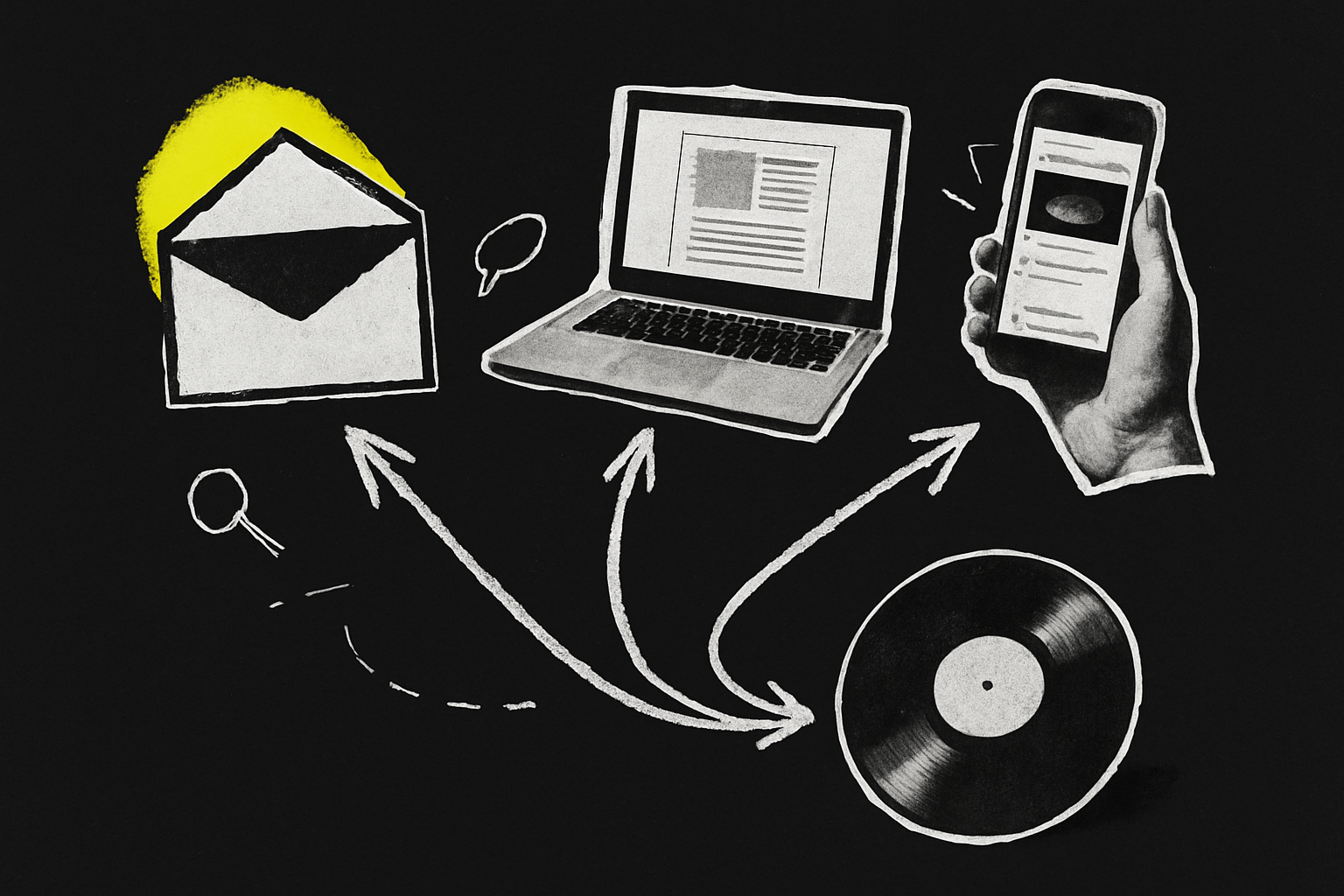
A B2B podcast distribution strategy puts each episode in front of a named set of buyers through channels you control: your email list, LinkedIn, an indexed episode page, your sales team’s inbox, and the guest’s own network. Podcast apps hold the file. They do not find your buyers. Distribution is the part that decides whether the show produces pipeline.
Publishing and distributing are separate jobs, and the second one rarely gets staffed. An episode goes live on Spotify and Apple, a link goes up on LinkedIn, one email goes out, and the team starts on the next recording. The asset exists. Almost nobody who matters has seen it.
Why does distribution get skipped when everyone agrees it matters?
The production loop is self-reinforcing. Record, edit, publish, repeat. Each step has a clear finish line and a visible artefact at the end, so it feels like progress. Distribution has no natural finish line, which is why it loses every week to the next recording date.
There is data on how podcasters actually behave here. Alex Sanfilippo of PodMatch, drawing on responses from more than 9,000 podcast hosts, found that the most common growth strategy was simply talking about the show with friends and family. It topped the list because it was the easiest thing to do, not because it worked. That pattern repeats inside B2B marketing teams with better resources and worse excuses: the tactic that gets done is the one with the lowest activation energy, and it is almost never the one that reaches a buying committee.
The commercial consequence is specific. You have paid for a guest’s time, a producer’s time, an editor’s time, and an executive’s hour, and you have converted all of it into one audio file sitting in a directory nobody in your target accounts browses. Then the CFO asks what the podcast returned this quarter.
Where should a B2B podcast be distributed?
Rank your channels by how much control you have over who sees the episode, and start at the top of that list. Podcast directories go last, not first, because they are storage, not reach.
Your email list is the highest-intent channel you own. Subscribers already asked to hear from you. An episode that gets its own send, with a reason to listen written for a specific role, will outperform the same episode buried three items down a monthly roundup. Segment where you can: an operations leader and a CFO will not click the same subject line about the same conversation.
Your website is where the episode becomes a durable asset. An episode page with full show notes, a transcript, and the topic written up properly gives search engines and AI assistants something to read, because they cannot listen. This is the difference between an episode that stops earning attention after fourteen days and one that keeps pulling traffic for two years.
LinkedIn is where most B2B buyers spend their scrolling time, and it punishes link posts. Treat every episode as source material for native content: a standalone argument in text, a clip that makes sense without context, a question that provokes replies from the people you want in the room. The link goes in the comments or nowhere. Posting “new episode is live” and expecting reach is the most common self-inflicted distribution wound in B2B.
Your sales team is the channel with the shortest path to revenue, and the one almost nobody activates. A rep sending a specific episode to a specific prospect, with a line about why it applies to their situation, does more commercial work than a thousand passive downloads. That requires the reps to know what exists. A simple internal index, organised by buyer problem rather than by episode number, closes that gap.
Guests carry the show into networks you cannot buy your way into. Every guest has a following, an email list, and colleagues who will click because their name is attached. Asking them to “feel free to share” produces nothing. Sending them a pack, a pre-written LinkedIn post they can publish unedited, a cut clip, a quote graphic with their name on it, produces shares because you have removed all of the work.
Podcast directories, Apple and Spotify and the rest, still matter. They are where a subscribed listener consumes the file. They are not a discovery engine for a niche B2B show, and building a strategy on the assumption that browsing listeners will find you is how shows end their first year with 200 downloads and no meetings.
| Channel | What it actually does | Control over who sees it | Effort per episode |
|---|---|---|---|
| Email list | Reaches people who already opted in | High | Low |
| Episode page and transcript | Builds a searchable asset that compounds | High | Medium |
| LinkedIn native content | Reaches buyers who never subscribe | Medium | Medium to high |
| Sales team outreach | Warms named accounts in live deals | High | Low, once indexed |
| Guest amplification | Borrows an audience you cannot buy | Low | Low, if you supply the assets |
| Podcast directories | Hosts the file for existing subscribers | None | Minimal |
Does anyone find B2B podcasts by searching?
They find the page, not the audio. Buyers search for answers to the questions your episodes cover, and the thing that can rank for those questions is a written episode page: title, description, show notes and a full transcript, structured around the topic rather than the guest’s job title.
This is the channel B2B teams chronically underinvest in, and the reason is that transcripts and show notes look like admin. They are inventory. An episode about renewal forecasting becomes a page that answers a renewal forecasting question, and that page keeps working while you sleep. Embedding the player in a blog post with the transcript underneath turns each episode into something an interested visitor can read, skim, or listen to, which is how you catch the buyer who will never install a podcast app.
Directories and aggregator sites add a second effect: listings and cross-promotion produce links back to your site, which supports the pages doing the ranking.
Search is also changing shape. When a marketing leader asks an AI assistant how to solve a problem in your category, the assistant reads text. It cannot listen to your show. If your point of view exists only as audio, it is invisible to the fastest-growing route buyers use to shortlist vendors. Transcribing and writing up every episode is now the cost of being quotable.
Name your episodes for the problem, not the person. “How Mid-Market CFOs Are Rebuilding Forecasting After a Bad Quarter” is searchable. “Episode 47 with Dave” is not.
How much distribution work does one episode need?
Plan for roughly as much effort after the recording as before it. One hour of conversation should produce several weeks of material across channels, and that only happens if the repurposing is decided before you press record.
The practical test is whether you can answer three questions before the session: what the single argument of this episode is, which two or three moments you intend to clip, and which written asset the transcript will become. Planning distribution in advance changes how you host. You ask the question that produces the clip. You get the guest to state the contrarian position cleanly instead of hedging through it. The material travels because you built it to travel.
A workable cadence for one episode looks like this: the episode page and transcript publish on day one alongside a dedicated email send; a native LinkedIn post from the host carries the core argument in the first week; two or three clips go out over the following fortnight; the guest’s asset pack lands the day the episode goes live, while they still care; and the transcript becomes a written piece four to six weeks later, when the audio has stopped producing new attention. The episode then goes into the sales index and gets sent to prospects for as long as the topic stays relevant.
That is the volume of work. It is not glamorous, and it is why so many shows quietly abandon it. Where teams get this wrong is treating distribution as a burst around launch day. An episode published in March should still be reaching new people in September, because the topic did not expire and the buyers who needed it in September were not looking in March.
What should you stop doing?
Three habits eat most of the available return.
Posting a link to the episode and calling it promotion is the first. Platforms suppress outbound links, and a link post asks the reader to leave and commit forty minutes before they know whether it is worth it. Give them the argument in the post itself.
Measuring the show on downloads alone is the second. Downloads tell you the file was fetched. They tell you nothing about whether the head of procurement at a target account listened, or whether a deal moved. Track which named accounts appear in the guest list, how many guests turn into conversations, what traffic the episode pages pull, and which episodes reps are actually sending. Those are the numbers that survive a budget review.
Treating the guest booking as separate from the marketing is the third. Who you invite is a distribution decision as much as a content one. A guest from a target account brings their network and gives your team a legitimate reason to be in conversation with someone who would decline a sales call.
How do you decide where to spend limited distribution time?
Start with the constraint you actually have, then pick the two channels that address it. Trying to run all six well from month one produces six half-executed channels and a team that resents the podcast.
If the problem is that nobody knows the show exists, put the effort into guest amplification and LinkedIn native content. Both borrow attention from audiences you have not built yet, and both produce visible signal quickly enough to keep internal support alive.
If the problem is that people listen but nothing commercial happens, put the effort into the sales index and the email list. The audience already exists; the missing piece is a route from listening to a conversation. Getting reps to send specific episodes into live deals is the shortest version of that route.
If the problem is that the show has no compounding value and every episode starts from zero, put the effort into episode pages and transcripts. It is the slowest channel to show returns and the only one that keeps paying after you stop.
If the problem is executive scepticism about the whole programme, put the effort into whichever channel produces evidence fastest, which is usually guest conversations. Booking buyers as guests generates meetings you can point to inside a quarter.
What does this mean for how you resource the show?
Distribution work is a different job from production work, and it needs different people or an explicit block of someone’s week. Editors edit. They do not write LinkedIn posts, brief the sales team, or chase a guest’s marketing department for a share. If you assign distribution to whoever has spare time, it will not happen, because nobody has spare time.
The costs that move a podcast budget are worth understanding before you scope anything. Episode volume is the obvious one. Video adds materially to production and to the clip work that follows. Whether guest research and booking sit with you or with a partner changes both the price and the quality of the guest list. And distribution scope, whether you are buying edited audio or edited audio plus transcripts, episode pages, clip packages, guest asset packs and a sales enablement layer, is usually the biggest single swing. When you ask for a quote, ask what happens to an episode after it is published, and get the answer in writing. Two proposals at the same number can contain entirely different amounts of the work that produces pipeline.
Distribution is also the part clients most often assume is included and most often is not. As a B2B podcast agency, we spend more time arguing about what happens in the four weeks after publication than about what happens in the studio, because that is where shows either build pipeline or quietly stop mattering.
The decision, stated plainly
A podcast with mediocre audio and disciplined distribution beats a beautifully produced show that nobody is told about. Buyers do not grade your compression settings. They notice whether your point of view keeps turning up in the places they already spend attention, and whether the person who eventually calls them has something worth saying.
Pick two channels. Build the routine so it survives a busy month. Make the guest a partner rather than an afterthought, put every word of every episode on a page a search engine can read, and give your sales team a reason to open the show. Then keep doing it long enough for the library to compound, because the show that works in year two is the one that was distributed properly in year one.